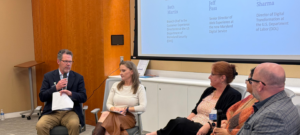


Drupal GovCon returned to the University of Maryland last month, bringing together federal Drupal practitioners to compare notes on what’s working, what isn’t, and where digital delivery is headed next. RIVA sponsored the event, joined by members of our Drupal Community of Practice and leaders from our largest federal enterprise Drupal programs.
Federal Drupal is a small community. The person next to you in a session is often solving the same problem you are. That’s what keeps us coming back. Three takeaways stood out from this year’s event.
AI Moved from the Keynote to the Backlog
A year or two ago, AI at a Drupal event meant a demo and some speculation. This year, conversation focused on control rather than capability, on the unglamorous “middle of the work,” where the actual questions live:
- How do you separate an AI module’s interface from its policy layer, so an agency isn’t hard coded to one vendor’s model?
- Where do permissions, logging, and cost controls live?
- Who owns the taxonomy and content definitions before an AI capability gets pointed at them, especially when that authority often has no obvious home on a federal program?
- On migrations, how do you use AI to parse legacy HTML into structured fields instead of bulk-moving pages as undifferentiated content, while keeping a human in the loop on classification?
That last question is the one we keep coming back to. The teams turning legacy content into structured, usable aren’t the ones with the most impressive AI demo. They’re the ones whose content is modeled cleanly enough for a machine to make sense of it. At RIVA, we think that’s where the real value in AI sits, not in the demo, but in the modeling underneath it.
Content Strategy is Becoming Infrastructure
Content strategy work that once looked like housekeeping now foundational to whether AI works at all. A content inventory and ROT analysis, a well-built content model, disciplined metadata, and a strong search strategy determine whether an agency can safely and effectively point an AI capability at its own material. Agencies that skipped the foundational work are finding that AI applied to unstructured, redundant, or out-of-date content mostly produces confident nonsense at scale.
RIVA built AiDX, our AI Integrated Digital Experience solution, on this same principle.
Analytics follows the same logic. AI can flag an anomaly in traffic or engagement data in seconds but deciding whether it’s worth acting on still requires the qualitative research that explains what a user was trying to do. That mix of quantitative and qualitative data is what turns an AI-generated signal into an operational decision instead of just another dashboard alert. In the federal space, that work is shaped by Section 508, the 21st Century Integrated Digital Experience Act, Executive Order 14058, and OMB M-23-22.
Traffic to Federal Sites is Changing Shape
Federal websites are absorbing heavier loads from AI crawlers, turning what was once a nuisance into a real availability concern. At the same time, traditional organic search traffic is trending down while discovery through AI agents is increasing. The public is more often encountering agency content secondhand, summarized or interpreted by a system rather than read directly on the page.
That changes the role of some very familiar web disciplines. Clean content structure, accurate metadata, and plain language are no longer just accessibility or search considerations. They increasingly shape how an agency’s information is understood and represented by AI systems.
In that sense, accessibility and AI readiness are more connected than they may seem. Sites that are readable by assistive technology tend to be more readable by everything else too.
The Best Ideas Didn’t Stay in the Sessions
Some of the best conversations we had all week happened at our booth, and most of them came back to the same question: how do you get AI into Drupal and enterprise web workflows without breaking the governance and accessibility commitments an agency has already made? We talked through approaches we’re using across our federal portfolio, including recent work on NRC.gov. We learned as much from hearing how other teams are solving it as we shared.
What We’re Taking Forward
AI is already reshaping federal digital experience, but it’s only as useful as the foundation underneath it. Content, governance, accessibility, analytics, and structure have to work together, or agencies get the confident nonsense we mentioned above instead of real value.
We’re working through these same challenges across RIVA’s federal Drupal programs, which is exactly why comparing notes with this community matters to us. We were glad to sponsor Drupal GovCon this year and look forward to doing it again in 2027.
Related Articles